
 LukasandRustDesk
fdffc37bb0
* fix(server): ignore spaces around IP whitelist entries

* fix(server): parse the IP and ID whitelists the same way, and fail closed

Both checks now read their option through one parser that accepts the
separators the settings dialogs accept (commas, semicolons, whitespace) and
drops empty entries. The IP whitelist split only at commas, so an entry
with a space around it, or a list from custom client settings separated by
semicolons or newlines, matched no address and locked the listed ones out.

A list is off only when the option is empty or holds only commas, which is
how the dialogs store a cleared list. Any other value without entries, such
as a lone space, now blocks every peer for the ID whitelist too, where it
used to let everyone in.

* fix(flutter): skip empty entries in the IP whitelist dialog

A leading or trailing comma gave an empty entry that the dialog rejected
as an invalid IP. Drop empty entries before the check, as the ID whitelist
dialog already does.

* fix(flutter): reject whitelist input that holds only separators

Dropping empty entries made the IP dialog save `,` or `;` as a cleared
whitelist, which turned the restriction off; before, that input failed
the IP check, and the server reads the same text as a list that allows
no one. Both dialogs now split through whitelistInputEntries, which
returns null for separator-only input, and show "Invalid IP" or "Invalid
ID" for it. Empty input and the Clear button still clear the whitelist.

* fix(flutter): keep a whitelist that lets no one in when its dialog is saved unchanged

A stored whitelist such as " , " is on but names no entry, so the server
lets no one in. Its dialog shows it as blank lines, and OK pressed
without an edit trimmed those to an empty field and saved a cleared
whitelist, lifting the restriction.

Both dialogs now take the shown text from whitelistDialogText and, when
the field is unchanged and whitelistLetsNoOneIn says the stored value
lets no one in, close without saving. Clearing the field and the Clear
button still clear the whitelist. The tests cover the load, unchanged
OK and save path for both cleared values (',' and '').

* style(flutter): drop a doubled blank line in whitelist_input.dart

* fix(ui): keep a whitelist that lets no one in when the Sciter dialog is saved unchanged

The Sciter IP whitelist dialog shows " , " as blank lines, trimmed the
submitted text before comparing it with what it showed, and so saved an
unchanged deny-all whitelist as a cleared one. The submitted text is now
compared first, as the Flutter dialogs do.

* test(flutter): name the round-trip test after the helper it checks

* fix(server): narrow the change to ignoring spaces around IP whitelist entries

As the review suggests, only the original fix stays: IP whitelist
entries are trimmed, so "192.168.1.0/24, 10.0.0.1" admits 10.0.0.1.

The ID whitelist keeps master's parsing and its "empty means allow"
behavior. The Flutter dialogs and the Sciter UI are back to master,
and the shared parse_whitelist and the dialog helpers are gone. The
trim lives in ip_whitelist_entries so that one regression test can pin
it. A whitespace-only IP whitelist still blocks everyone, as on master.

* Refactor IP whitelist entries handling and comments

Updated comments for clarity and adjusted whitespace handling in IP whitelist entries.

---------

Co-authored-by: RustDesk <71636191+rustdesk@users.noreply.github.com>

Build •
Docker •
Structure •
Screenshots
[Українська] | [česky] | [中文] | [Magyar] | [Español] | [فارسی] | [Français] | [Deutsch] | [Polski] | [Indonesian] | [Suomi] | [മലയാളം] | [日本語] | [Nederlands] | [Italiano] | [Русский] | [Português (Portugal)] | [Português (Brasil)] | [Esperanto] | [한국어] | [العربي] | [Tiếng Việt] | [Dansk] | [Ελληνικά] | [Türkçe] | [Norsk] | [Română]
We need your help to translate this README, RustDesk UI and RustDesk Doc to your native language
Caution
Misuse Disclaimer:
The developers of RustDesk do not condone or support any unethical or illegal use of this software. Misuse, such as unauthorized access, control or invasion of privacy, is strictly against our guidelines. The authors are not responsible for any misuse of the application.
Chat with us: Discord | Twitter | Reddit | YouTube

Yet another remote desktop solution, written in Rust. Works out of the box with no configuration required. You have full control of your data, with no concerns about security. You can use our rendezvous/relay server, set up your own, or write your own rendezvous/relay server.
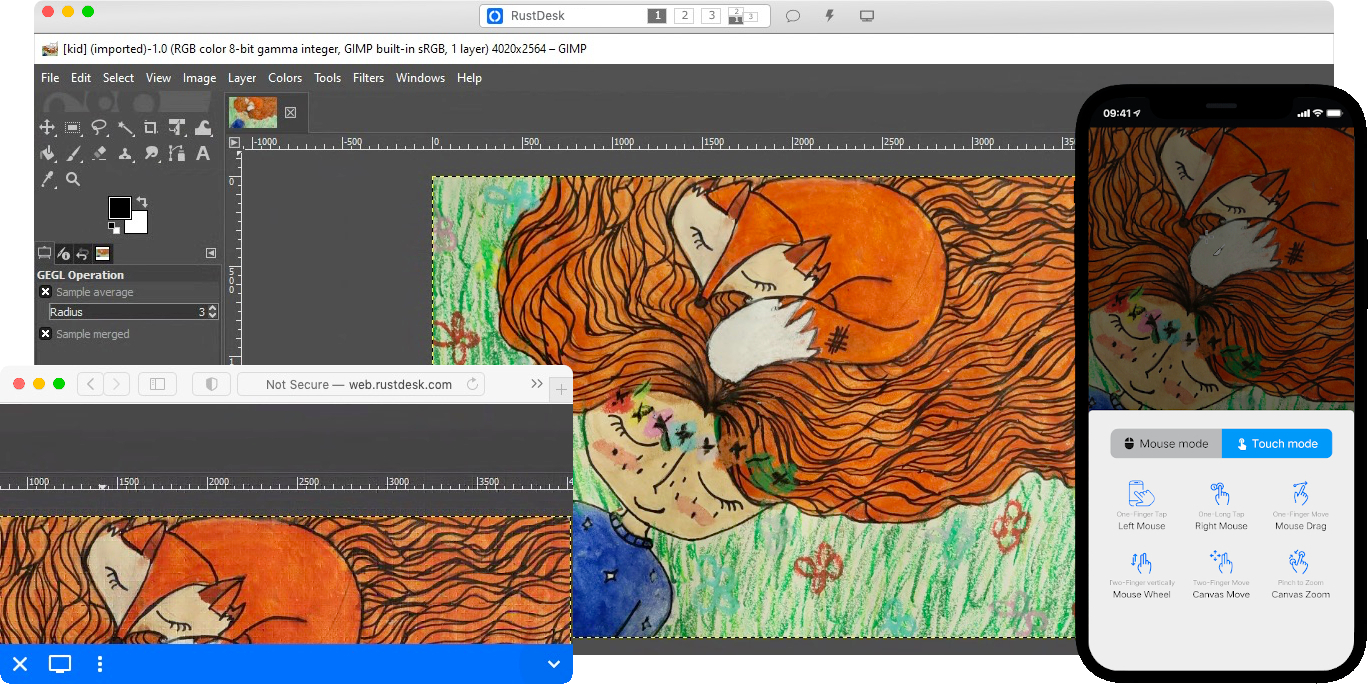
RustDesk welcomes contribution from everyone. See CONTRIBUTING.md for help getting started.

Dependencies
Desktop versions use Flutter or Sciter (deprecated) for GUI. This tutorial is for Sciter only, since it is easier and more friendly to start. Check out our CI for building the Flutter version.
Please download Sciter dynamic library yourself.
Raw Steps to build
-
Prepare your Rust development env and C++ build env
-
Install vcpkg, and set
VCPKG_ROOTenv variable correctly- Windows: vcpkg install libvpx:x64-windows-static libyuv:x64-windows-static opus:x64-windows-static aom:x64-windows-static
- Linux/macOS: vcpkg install libvpx libyuv opus aom
-
run
cargo run
Build
How to Build on Linux
Ubuntu 18 (Debian 10)
sudo apt install -y zip g++ gcc git curl wget nasm yasm libgtk-3-dev clang libxcb-randr0-dev libxdo-dev \
        libxfixes-dev libxcb-shape0-dev libxcb-xfixes0-dev libasound2-dev libpulse-dev cmake make \
        libclang-dev ninja-build libgstreamer1.0-dev libgstreamer-plugins-base1.0-dev
openSUSE Tumbleweed
sudo zypper install gcc-c++ git curl wget nasm yasm gcc gtk3-devel clang libxcb-devel libXfixes-devel cmake alsa-lib-devel gstreamer-devel gstreamer-plugins-base-devel xdotool-devel
Fedora 28 (CentOS 8)
sudo yum -y install gcc-c++ git curl wget nasm yasm gcc gtk3-devel clang libxcb-devel libxdo-devel libXfixes-devel pulseaudio-libs-devel cmake alsa-lib-devel gstreamer1-devel gstreamer1-plugins-base-devel
Arch (Manjaro)
sudo pacman -Syu --needed unzip git cmake gcc curl wget yasm nasm zip make pkg-config clang gtk3 xdotool libxcb libxfixes alsa-lib pipewire
Install vcpkg
git clone https://github.com/microsoft/vcpkg
cd vcpkg
git checkout 2023.04.15
cd ..
vcpkg/bootstrap-vcpkg.sh
export VCPKG_ROOT=$HOME/vcpkg
vcpkg/vcpkg install libvpx libyuv opus aom
Fix libvpx (For Fedora)
cd vcpkg/buildtrees/libvpx/src
cd *
./configure
sed -i 's/CFLAGS+=-I/CFLAGS+=-fPIC -I/g' Makefile
sed -i 's/CXXFLAGS+=-I/CXXFLAGS+=-fPIC -I/g' Makefile
make
cp libvpx.a $HOME/vcpkg/installed/x64-linux/lib/
cd
Build
curl --proto '=https' --tlsv1.2 -sSf https://sh.rustup.rs | sh
source $HOME/.cargo/env
git clone --recurse-submodules https://github.com/rustdesk/rustdesk
cd rustdesk
mkdir -p target/debug
wget https://raw.githubusercontent.com/c-smile/sciter-sdk/master/bin.lnx/x64/libsciter-gtk.so
mv libsciter-gtk.so target/debug
VCPKG_ROOT=$HOME/vcpkg cargo run
How to build with Docker
Begin by cloning the repository and building the Docker container:
git clone https://github.com/rustdesk/rustdesk
cd rustdesk
git submodule update --init --recursive
docker build -t "rustdesk-builder" .
Then, each time you need to build the application, run the following command:
docker run --rm -it -v $PWD:/home/user/rustdesk -v rustdesk-git-cache:/home/user/.cargo/git -v rustdesk-registry-cache:/home/user/.cargo/registry -e PUID="$(id -u)" -e PGID="$(id -g)" rustdesk-builder
Note that the first build may take longer before dependencies are cached, subsequent builds will be faster. Additionally, if you need to specify different arguments to the build command, you may do so at the end of the command in the <OPTIONAL-ARGS> position. For instance, if you wanted to build an optimized release version, you would run the command above followed by --release. The resulting executable will be available in the target folder on your system, and can be run with:
target/debug/rustdesk
Or, if you're running a release executable:
target/release/rustdesk
Please ensure that you run these commands from the root of the RustDesk repository, or the application may not find the required resources. Also note that other cargo subcommands such as install or run are not currently supported via this method as they would install or run the program inside the container instead of the host.
File Structure
- libs/hbb_common: video codec, config, tcp/udp wrapper, and some other utility functions shared with the server
- libs/base: protobuf, fs functions for file transfer, keyboard and platform code used only by this app
- libs/scrap: screen capture
- libs/enigo: platform specific keyboard/mouse control
- libs/clipboard: file copy and paste implementation for Windows, Linux, macOS.
- src/ui: obsolete Sciter UI (deprecated)
- src/server: audio/clipboard/input/video services, and network connections
- src/client.rs: start a peer connection
- src/rendezvous_mediator.rs: Communicate with rustdesk-server, wait for remote direct (TCP hole punching) or relayed connection
- src/platform: platform specific code
- flutter: Flutter code for desktop and mobile